

1978: Letter from Iran
 Letter From Iran published in December 1978, right before the fall of the Shah. In the article, just posted on The New Yorker’s Web site, Joseph Kraft writes about an interview with the Shah:
He looked pale, spoke in subdued tones, and seemed dwarfed by the vast expanse of the room, with its huge, ornate chandeliers and heavy Empire furniture. He wore a double-breasted suit whose blackness suggested mourning. He started with an apology. He was sorry to have kept me waiting. The American and British Ambassadors had been in to see him. “They tried to cheer me up,” he said. “As if there were anything to be cheerful about.”
I expressed surprise at—and, indeed, felt some suspicion about—this show of gloom. There had been demonstrations in many parts of the country, and strikes, but Teheran, apart from the university, seemed calm, and the Army was in thorough control. Moreover, the opposition was headed by the Moslem clergy, and they were clearly divided. Surely, I said, the factions could be played off against each other.
“Possibly,” the Shah said, shrugging his shoulders in an elaborate show of disbelief. [...]
If worst came to worst, I went on, there was always the Army. The military was strong, and its leaders were loyal. The Shah said that force had its limitations. “You can’t crack down on one block and make the people on the next block behave,” he said.
Continue Reading“The most surreal day of my life”
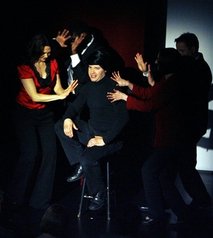 The case of Rod Blagojevich reveals that I have limited understanding of the human psyche. This guy is unbef*kinglievable! Read this story by the Associated Press that just came over the wire.
Blago guest stars in ‘Rod Blagojevich Superstar’. By RUPA SHENOY. CHICAGO - Standing on a chair with his arms raised as if he were being crucified, ousted Illinois Gov. Rod Blagojevich opened a comedy show Saturday evening lampooning the rise and fall of his own political career.
Blagojevich, who has pleaded not guilty to wide-ranging federal corruption charges, made what one cast member described as a “surreal” guest appearance on The Second City’s “Rod Blagojevich Superstar.”
The show, a takeoff of the rock opera “Jesus Christ Superstar,” was supposed to end June 14. But production officials extended the show—which portrays Blagojevich as greedy, tactless and hair-obsessed—to Aug. 9 because performances kept selling out.
The Curious Case of Benjamin Button
 The Curious Case of Benjamin Button is Hollywood at its best. The film lifts a simple idea from a short story of F. Scott Fitzgerald and turns it into first-class entertainment that touches on deep emotions of the human condition: being in love, getting older, and dying. Hollywood works its magic by hiring great writers (Eric Roth and Robin Swicord) who take Fitzgerald’s plot line of a baby boy who is born old and gets younger and put together a narrative that is much grander than the original short story. Add to this a competent director (David Fincher), two of today’s biggest stars in the leading roles (Brad Pitt and Cate Blanchett), and a team of splendid set and make-up designers. Voila, you have all the elements of a great movie. The only weakness in this production is the editor: The film could have been half an hour shorter. But the production is so good that you can even forgive this weakness.
Lawrence of Arabia
 Watching one of the great films in the history of the art form always fills me both with excitement and trepidation, particularly when the film was made a long time ago. Some films are timeless; others translate very poorly from the past into the present. Gone with the Wind bored the teenage me beyond belief because I felt that it was always clear that the actors were acting rather than truly experience the emotions of their characters. I thought the love story that allegedly existed between Scarlett O’Hara and Rhed Butler was simple fake, destroying the entire film for me. Many years ago I saw segments of Lawrence of Arabia but only now have I been able watch this three-and-a-half hour movie marathon in its entirety. One feels that the film was shot a few decades ago but this does not take away from its power. The Middle East is still in a political quagmire.
The Baader Meinhoff Complex
 In 1997, Heinrich Breloer made a spectacular docudrama (a documentary interspersed with acted drama) about the abduction of Hans Martin Schleyer, the head of the West German employer’s union, by the Red Army Fraction, a home-grown terrorist group, formed by Andreas Baader and Ulrike Meinhoff. The Baader Meinhoff Complex goes all the way to the beginning of the group in the late 1960s and tells the story of the group largely from the imagined perspective of the terrorists. Breloer’s Todesspiel (Death Game) was compelling because he helped you understand why the terrorist acted the way they did and why the state reacted the way it did. Breloer interviewed the families of the terrorists and victims, as well as the politicians who tried to defend the state against the terrorist group that tried to bring the state to its knees and overthrow capitalist institutions in the name preventing another social injustice on the scale of Nazi Germany.
Obama nominates a ”‘Kid From the Bronx’ With Hopes and Doubts”
 Just like Obama’s own biography, the life of Sonia Sotomayor is an inspirational story. It will be interesting to see how the Republicans will treat her in the nomination hearing.
NEIL A. LEWIS (NY) reports: Sonia Sotomayor, who would be the Supreme Court’s first Hispanic justice, brings to the confirmation experience the kind of rich personal story that has always been deeply gratifying to Americans, the journey from humble beginnings to a respected position of great influence.As she was presented by President Obama at the White House on Tuesday morning, she referred to herself as “a kid from the Bronx.” But it was Mr. Obama who provided many details of her history as a child of a city housing project who lost her father at an early age and saw her mother work two jobs to put her and her brother through professional schools.
Continue Reading
© 2026 Peter Murmann. Powered by ExpressionEngine.
